Amy’s Field Notes From Tanzania
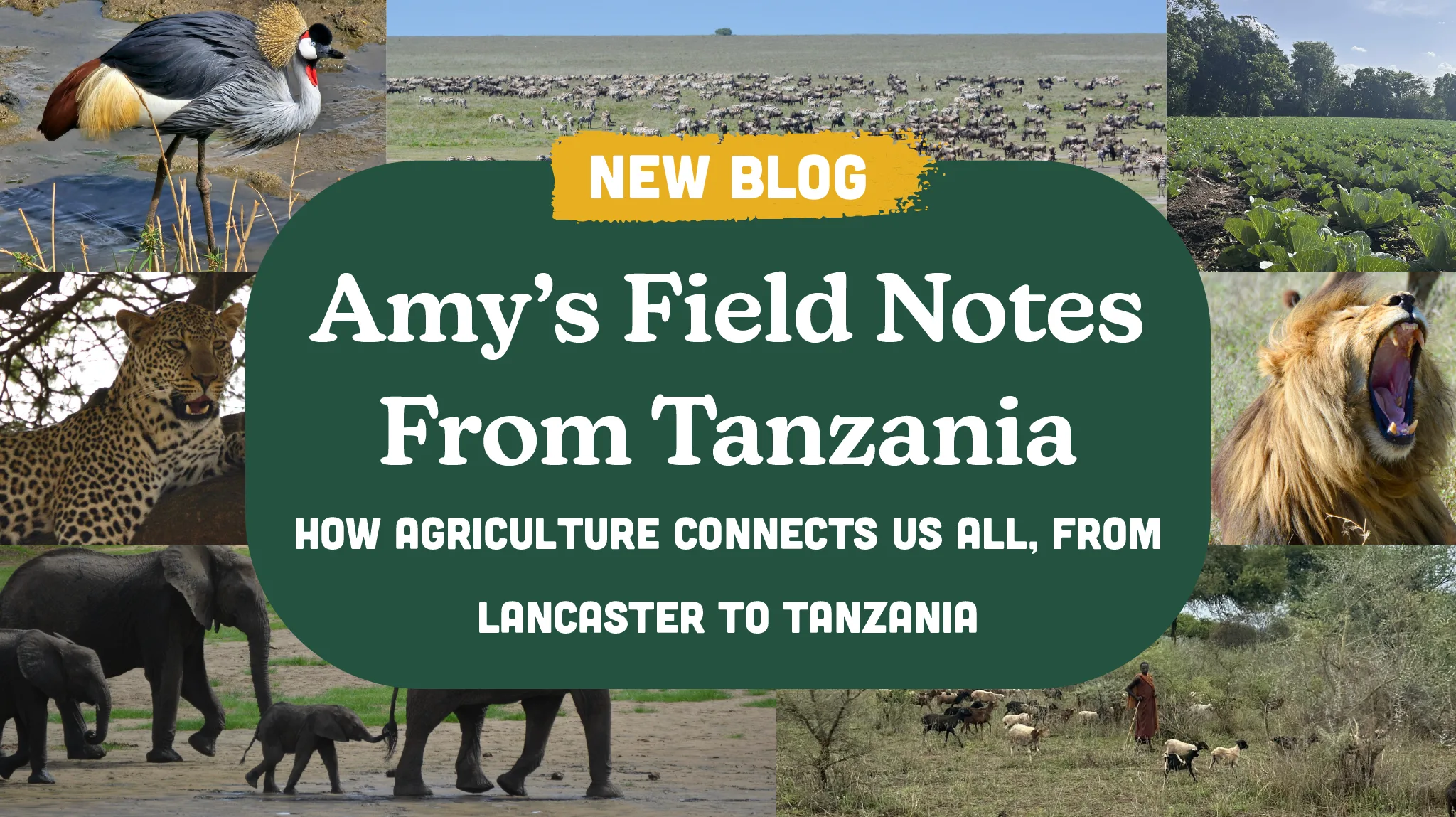
1,000-year-old Baobab trees. Three male lions taking down a 2,000-pound cape buffalo. 1,000,000 migrating wildebeest in the Serengeti. A New Holland tractor? These are just a few of the things I saw on a recent trip to Tanzania that left me marveling at the immense wonders of a place so far from home and yet surprised at how small the world can sometimes seem.
Over the winter holidays, my extended family and I had the unforgettable experience of traveling for two weeks in Tanzania, an amazing country of around 65 million people on Africa’s eastern coast. Malaki and Sultan, our intrepid guides, managed to wrangle a 13-person multi-generational family from Arusha to Tarangire National Park, through the Ngorongoro Crater, and across the Serengeti. They answered questions from the absurd to the complicated in a second language, drove and repaired land rovers like pros, spotted animals from imperceptible distances, and most importantly, shared their great pride and love for Tanzania, its people, and landscapes with our family…a feeling we now undoubtedly share.
Having worked at LFT for over 7 years now and lived in Lancaster for more than a decade, I find myself immediately looking at the agriculture in any new place I travel to. Tanzania did not disappoint. I was told during our trip that about 75% of Tanzania’s population is engaged in the agricultural sector. For comparison, around 17% of Lancastrians are estimated to work in the industry. We spent our first several days in Arusha, a city at the base of Mt. Meru with Mt. Kilimanjaro peeking out in the distance.
Agriculture was not far from anywhere you looked. The climate allows for two growing seasons, and the volcanic soil supports products we can’t grow here in Lancaster, like coffee, bananas (so many kinds and colors!), papayas, avocados, mangoes, and pineapples. My fruit-loving children were in heaven. But there was plenty to remind me of home. Deep, rich soil growing cabbage, corn, potatoes, flowers, and street-side nurseries that could have been plucked right out of Lancaster’s back roads.
Right outside and between the various national parks, we often crossed paths with Maasai people grazing herds of cattle, goats, and sheep. Frequently in their distinct red clothing, these members of the nomadic, pastoral Maasai tribe move with their herds across the landscape. Unlike Lancaster’s own grazing systems, there was an obvious absence of fencing, slimmer cattle that traveled greater distances, and the clear, charming sound of cowbells sounding amongst the moving herds. Our family had the incredible opportunity to meet, eat, and even dance with Maasai tribesmen and women. Witnessing a community who has chosen to maintain so much of their cultural distinctiveness, heritage, and commitment to the land – did not seem so far from home.
In many rural communities close to conservation areas, I spotted white or gray boxes seemingly dangling from thin wire fences. Bee box fencing is an innovative way to reduce human-animal conflict in areas where crop-raiding by elephants occurs. When elephants bump into the wire-strung hives, agitated bees drive them away from the crop fields. Certainly, one of my new favorite best management practices!
Over 40% of Tanzania’s land is under some form of protection. We spent time on much of that land, traveling to Tarangire National Park, the Ngorongoro Conservation Area (colloquially known as the Garden of Eden), and the Serengeti National Park. I was told the green portion of Tanzania’s flag represents the country’s rich land and commitment to conservation. Yet another characteristic that felt like home. Our own Lancaster community has successfully preserved around 30% of the available farmland.
Now, did the protected land in Tanzania look like ours? I was blessed to see two leopards in trees, a 17-member lion pride, a mother cheetah teaching her cubs to hunt, a secretary bird “typing” a snake, baby elephants running in and out of their mother’s legs, and more giraffes, wildebeest, zebras, and dung beetles than I could count. So no, the land and its inhabitants are certainly not the same. But on an early evening game drive as we left a group of hippos in Ndutu Lake, a Land Rover was stuck in the muck by the water’s edge. Many people were out trying to help. And who came around the bend to get the car out? A bright blue New Holland tractor. Sometimes there’s no place like home.
