Saving Farms, Saving Water
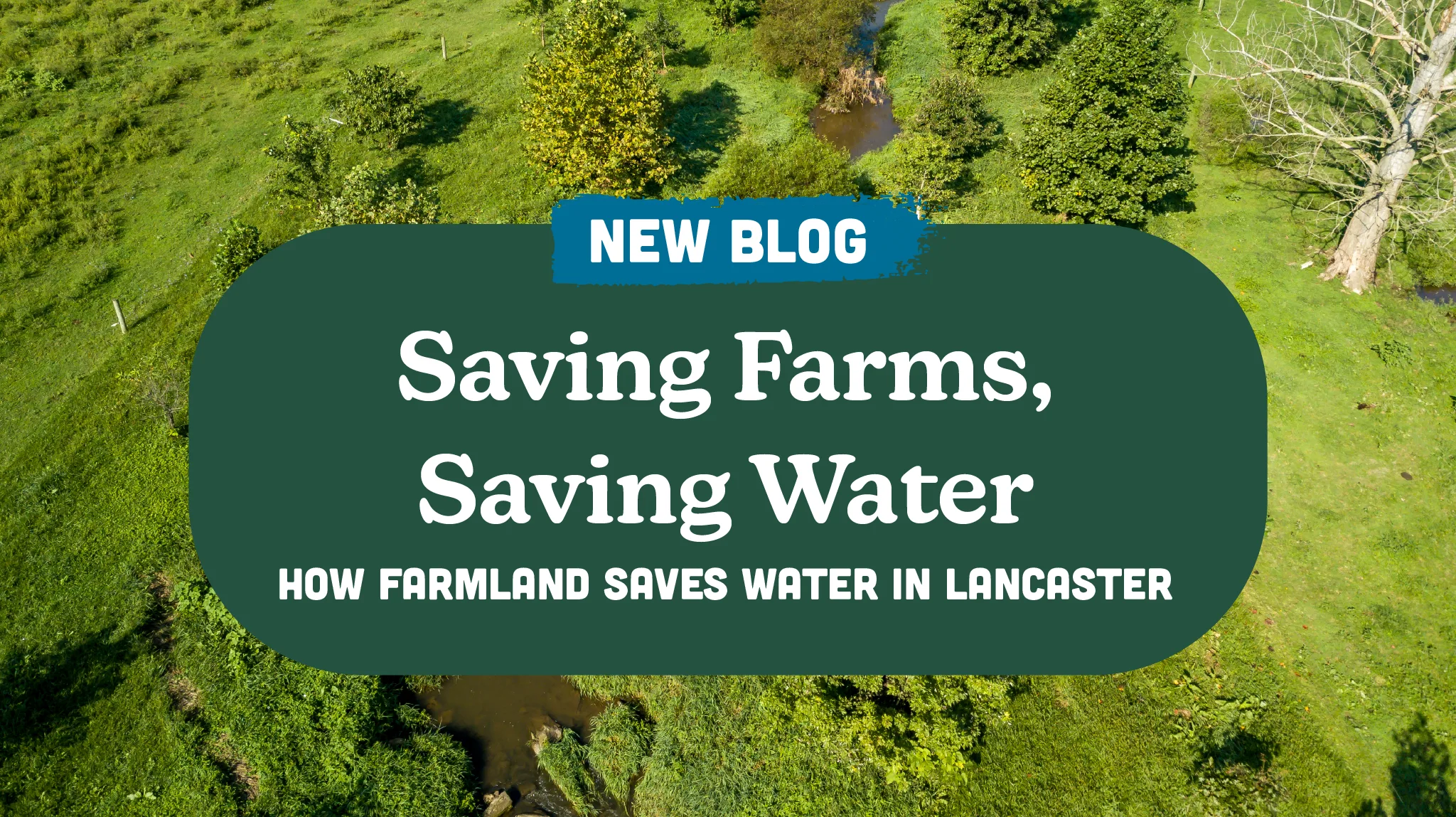
Some benefits of farmland preservation are more obvious than others. Fresh local food, scenic views, productive soil, and economic advantages jump to mind quickly when we think about the value of our farmland here in Lancaster County. But did you know that well-managed preserved farms can help save water and improve water quality?
Lancaster County is blessed with the most productive non-irrigated soil in the United States;
meaning farmers in Lancaster are mostly reliant on rainfall, and subsequently the water cycle,
to nourish their crops. In a well-working hydrologic cycle, water naturally recharges itself,
evaporating into the atmosphere and then returning to the earth’s surface as precipitation. On
land, precipitation is absorbed into the ground and collects as groundwater. Ideally, farmers and communities want water to be soaked into the ground rapidly and released slowly. This is good for soil and water quality. Precipitation, however, does not always seep into the ground. It also collects on the surface as runoff, especially during heavy weather events. As more development occurs, more natural land is replaced by impervious surfaces, like roads, buildings, and parking lots.
In other words, we don’t necessarily have a runoff problem, but an infiltration problem. When our farms and natural lands are paved over with development and macadam, water and nutrients cannot infiltrate the soil – instead, they run off into our streams and creeks. The very best way to improve Lancaster County’s water quality is to preserve farmland, thereby protecting the soil that soaks up water and nutrients.
In their study of Lancaster County’s agricultural land, Earth Economics discovered that a typical 85-acre farm collects 34 million gallons of groundwater from rain, while the cows and family that live on that same acreage use about 1 million gallons of water themselves. The result: 33 million gallons of groundwater contributed by an average farm family. If 300 houses are built on those same 85 acres, a not-so-uncommon occurrence in Lancaster County, the housing development would collect 1/3 less groundwater, while using over 16 million gallons itself. The result: 26 million fewer gallons of groundwater collected. Preserving farmland and protecting it from this type of development is a crucial way to maintain groundwater recharge and protect water resilience.
So yes, preserved farmland at the very least protects water quantities, as LFT’s easement requires that the farm remain available for agricultural use. This limits the amount of impervious surface allowed at any point in the future and therefore protects the land’s natural ability to act as an infiltration mechanism for precipitation. But preserved farmland can do more. It can also improve water quality by implementing best management practices (BMPs)—effective on-farm methods to keep nutrients and sediment on the farm and out of our local waterways and the Chesapeake Bay.
Successful farmers understand the value that both water and manure play in the health of their crops and pastureland. Spreading manure and other nutrients on fields at the right time, right rate, and right place will maximize the farm’s efficiencies. However, inadequate manure storage can prevent a farm family from being able to utilize their manure to its fullest potential. They may be required to spread manure at times when crop uptake is not at its highest, and the potential for large runoff events is more likely. Additionally, the areas of a farm where animals congregate, like the farm’s barnyards and animal loafing areas, can contribute to this nutrient problem as well.
If these areas are not stabilized with stone or concrete, or have inadequate water controls such as gutters and drainage outlets, heavy rain events or snowmelt may flush the nutrients in those areas into the waterways, leading to large pollution runoff events. Implementing structural agricultural BMPs allows a farmer to keep the farm’s nutrients in the right places until it is the appropriate time to spread. This will not only save a farm family time, money, and headaches, but also support the family’s field-based conservation efforts to best steward the water on their property.
Field-based best management practices, like no-till, cover crops, contour farming, and crop rotation, can be just as important as the structural BMPs mentioned above. Once farmers spread those nutrients, these BMPs keep those nutrients and fertilizers in place on the land. To help nutrients infiltrate the soil and reduce the risk they runoff into the waterways, farmers need to keep soil covered, minimize soil disturbance, maximize living roots and soil health, and energize their fields with diverse plantings.
The final defense against nutrient runoff from a farm is protecting a stream on the property. This can include the installation of structural BMPs like animal crossings and fencing that keep animals out of the water, or the implementation of a buffer along a property’s waterway. Stream buffers are areas of grassy or forested vegetation next to streams. These areas are taken out of agricultural use – fencing excludes animals to protect the stream banks, and then grasses, shrubs, and trees are planted to trap nutrients and sediment still running off the farm property and catch them before they enter the waterways. Buffers can also serve to enhance the quality of life in a stream by providing bank stabilization, fish habitat, and shade.
Many of these BMPs, especially structural and streambank work, have implementation costs. Farmers often must work with specialized agricultural engineers, secure funding, obtain permits, and adjust their operations to bring these projects to fruition. LFT assists farmers with this usually complicated and often expensive process and has completed over 50 BMP projects in the last decade. Currently, LFT has 35 active projects moving – all on preserved farms! Preserved farmers in Lancaster County are doing their part to improve local water quality and, in turn, the health of the Chesapeake Bay.